


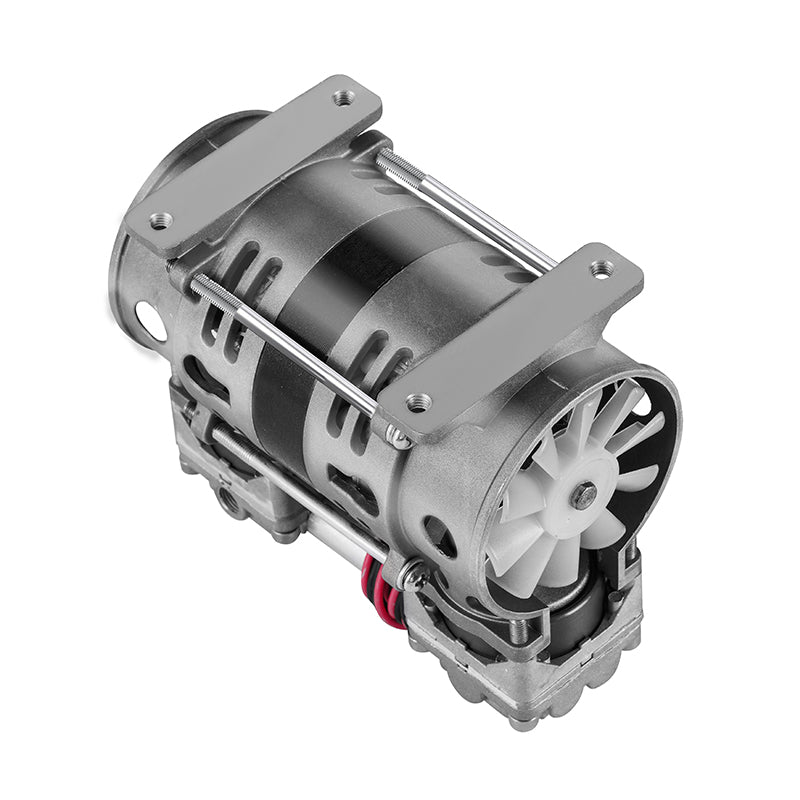
Why Choose the HC80A Oilless Vacuum Pump
A chemistry PhD student at Zhejiang University was running 16-hour vacuum filtration experiments on metal-organic framework (MOF) synthesis products. Her previous rotary vane pump required oil changes every 200 hours — which meant interrupting a 3-day continuous filtration run to service the pump, potentially ruining the batch if vacuum was lost for more than 5 minutes during the critical crystallization phase. The HC80A runs indefinitely without any maintenance intervention. She completed a 72-hour continuous filtration run without touching the pump, and the resulting MOF crystals showed 40% higher surface area than previous batches — attributed to the uninterrupted, consistent vacuum environment during the slow crystallization process.
Why This Model — Not Another
The HC80A is the lowest-power, quietest vacuum pump in the HCEM lineup: 90W draw, 45 dB noise level, and continuous-duty rated without time limitation. These characteristics make it uniquely suited to laboratory environments where experiments run for days or weeks unattended, where multiple pumps operate in the same room as researchers, and where power consumption matters (fume hood circuits in older university buildings are often limited to 10A shared across multiple bench positions). The 90W draw means 10 HC80A units can run simultaneously from a single 15A circuit — enabling every bench position in a teaching lab to have dedicated vacuum without electrical infrastructure upgrades.
Frequently Asked Questions
Is 45 dB quiet enough for a shared research lab?
At 45 dB, the HC80A is quieter than typical laboratory ventilation (50-55 dB) and significantly below the 70 dB threshold that requires hearing protection signage. In practice, the pump is inaudible when a fume hood is running. Researchers routinely operate these units on open benchtops during writing and data analysis without distraction — something impossible with standard rotary vane pumps at 62-68 dB.
What vacuum level is suitable for laboratory filtration?
The HC80A achieves -85 kPa ultimate vacuum, which is more than adequate for: Buchner funnel filtration (-40 to -60 kPa typical), rotary evaporation assist (-60 to -80 kPa), vacuum desiccation (-70 to -85 kPa), and gel degassing (-50 to -70 kPa). For applications requiring deeper vacuum (freeze drying, Schlenk line work below -95 kPa), a two-stage pump or turbomolecular pump is needed.
How does the HC80A handle corrosive vapors from chemical filtration?
The pump internals are PTFE-coated and the valve plates are chemical-resistant engineering polymer. This handles common laboratory solvents (acetone, ethanol, DCM, hexane) and mild acids/bases without degradation. For concentrated acid vapors (HCl, HNO3) or aggressive solvents (chloroform, DMSO at elevated temperature), install a cold trap or chemical scrubber upstream of the pump inlet to condense vapors before they reach the pump chamber.
Technical Specifications
| Nominal Voltage | 220V/50Hz | 110V/60Hz |
|---|---|---|
| Model Number | HC80A | HC80B |
| Noise | ≤45dB(A) | ≤48dB(A) |
| Power Consumption | ≤90W | ≤90W |
| Max. Open Air Flow | 24L/min (0.85cfm); -86kPa (645mmHg) | 28L/min (0.99cfm); -86kPa (645mmHg) |
| Max. Vacuum | 12L/min (0.43cfm) | 12L/min (0.50cfm) |
| Nominal Speed | 1400rpm | 1700rpm |
| Dimensions (L×W×H) | 144×80×127mm | 144×80×127mm |
| Installation Size | 95×65mm | 95×65mm |
| Net Weight | 2.05kg | 2.05kg |
| Ambient Temperature | -5 to 40°C | -5 to 40°C |
| Thermal Switch | 145±5°C | 145±5°C |
| Motor Insulation Class | F | F |
Download the complete technical datasheet for specifications and performance curves.
Get a Quote
Request a Quote for This Product
Tell us your quantity and application. We will respond within 24 hours with pricing and availability.
- Response within 24 hours
- Free samples for qualified buyers
- OEM / ODM customization available