


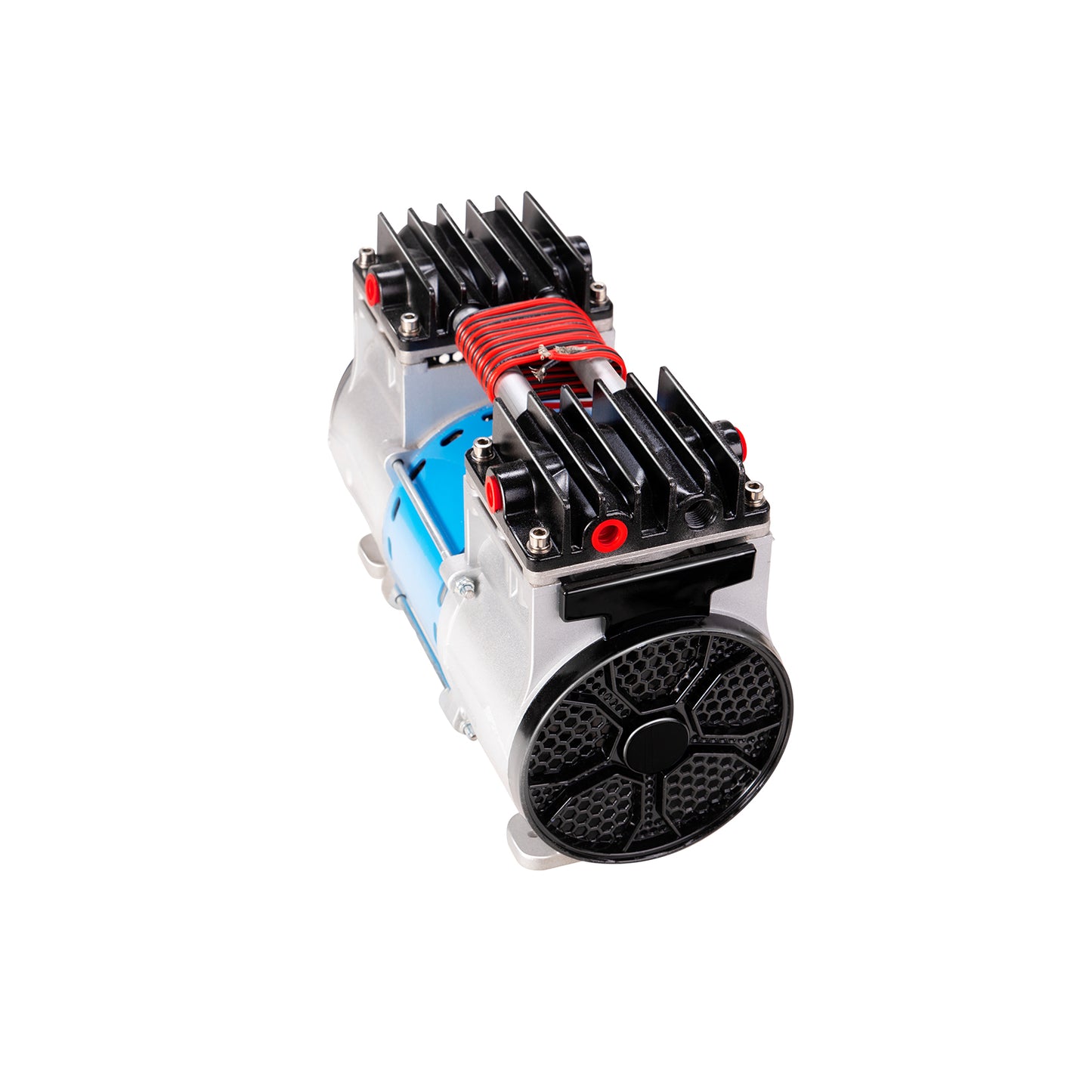
Why Choose the HC550A Oilless Vacuum Pump
A PCB fabrication shop in Huizhou was experiencing intermittent solder mask adhesion failures on their finest-pitch boards (0.1mm trace/space). Root cause analysis traced the defect to incomplete vacuum lamination — their existing vacuum pump couldn't maintain sufficient vacuum across the full 600x500mm panel area during the 45-second lamination cycle. Vacuum level would start at -90 kPa but decay to -72 kPa by cycle end as the pump couldn't overcome the cumulative leak rate of the aging lamination chamber seals. The HC550A's 95 L/min displacement maintains -88 kPa or better throughout the entire cycle, even with the chamber's 3 L/min leak rate, eliminating the adhesion defects entirely.
Why This Model — Not Another
The HC550A delivers 95 L/min displacement at 200W — the highest flow-per-watt ratio in the HCEM vacuum pump lineup. This efficiency matters in PCB manufacturing where multiple vacuum consumers (laminator, exposure unit, developing tank, AOI fixture) operate simultaneously from a shared vacuum manifold. The 200W power draw means 4-6 units can run from a single 15A circuit, enabling distributed point-of-use vacuum without expensive central vacuum plant infrastructure. For PCB shops scaling from prototype to volume production, adding HC550A units incrementally as new equipment comes online is far more capital-efficient than installing an oversized central system upfront.
Frequently Asked Questions
What ultimate vacuum does the HC550A achieve?
Ultimate vacuum (no-load, dead-end): -92 kPa (70 Torr absolute). Working vacuum with typical PCB laminator leak rate (2-5 L/min): -85 to -90 kPa sustained. This exceeds the -80 kPa minimum required by all major dry-film laminator manufacturers (Dynachem, Hitachi, Dupont) for reliable adhesion on fine-pitch geometries.
How does oil-free operation benefit PCB vacuum lamination?
Oil backstreaming from rotary vane pumps deposits a molecular film on the laminator's heated platen surface. This film transfers to the copper surface during lamination, creating a release layer that causes dry-film delamination during subsequent developing. The HC550A eliminates this contamination mechanism entirely — no oil in the system means no possible backstreaming path. Shops switching from oiled pumps typically see lamination yield improve 2-4% within the first week.
Can one HC550A serve multiple PCB process stations?
At 95 L/min, one unit supports 2-3 typical vacuum consumers simultaneously (laminator + exposure unit + one fixture). For larger shops with 5+ simultaneous consumers, use multiple units on a common manifold with a small vacuum receiver (20-50L) to buffer transient demand spikes during simultaneous cycle starts.
Technical Specifications
| Nominal Voltage | 220V/50Hz | 110V/60Hz |
|---|---|---|
| Model Number | HC550A | HC550B |
| Noise | ≤53dB(A) | ≤55dB(A) |
| Power Consumption | ≤200W | ≤260W |
| Max. Open Air Flow | 95L/min (3.35cfm); -92kPa (690mmHg) | 100L/min (3.53cfm); -92kPa (690mmHg) |
| Max. Vacuum | 47.5L/min (1.68cfm); -98kPa (735mmHg) | 50L/min (1.77cfm); -98kPa (735mmHg) |
| Nominal Speed | 1400rpm | 1700rpm |
| Dimensions (L×W×H) | 275×130×189mm | 275×130×189mm |
| Installation Size | 223×89mm | 223×89mm |
| Net Weight | 8.5kg | 8.5kg |
| Ambient Temperature | -5 to 40°C | -5 to 40°C |
| Thermal Switch | 145±5°C | 145±5°C |
| Motor Insulation Class | F | F |
| Capacitor Value | 12.5μF | 45μF |
Download the complete technical datasheet for specifications and performance curves.
Get a Quote
Request a Quote for This Product
Tell us your quantity and application. We will respond within 24 hours with pricing and availability.
- Response within 24 hours
- Free samples for qualified buyers
- OEM / ODM customization available