


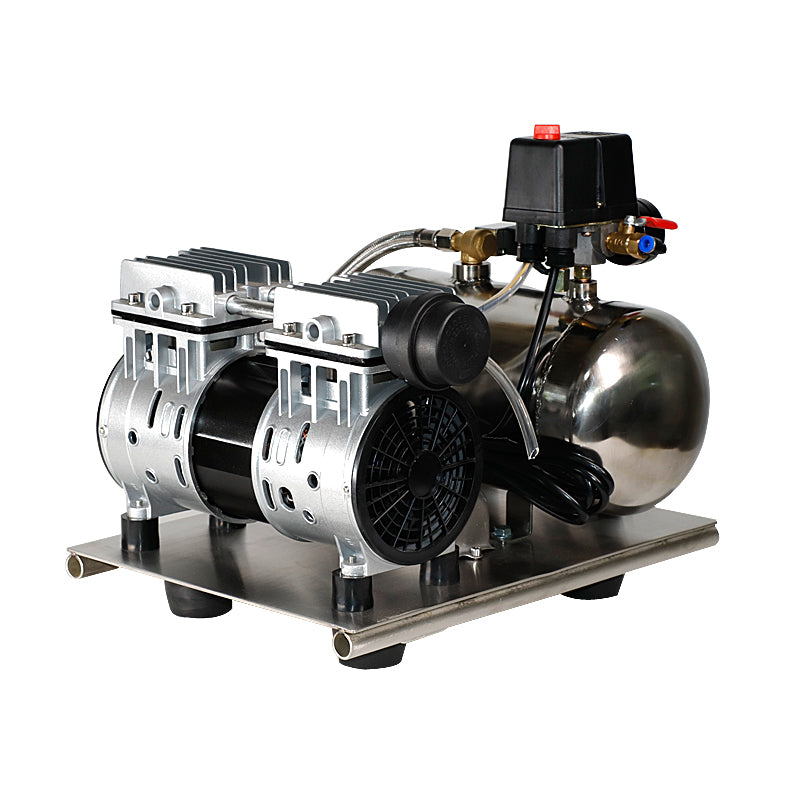
Why Choose the HC5501-6--HC7501-6
A ceramic tile manufacturer in Foshan runs 12 hydraulic presses that each require 800 L/min of clean compressed air for mold release and tile ejection. Their three aging screw compressors consumed 45 kW each and required $12,000/year in oil, filters, and scheduled maintenance per unit. When two failed simultaneously during peak summer production, the 3-week repair lead time cost the factory $280,000 in lost output. The plant engineer replaced all three with a bank of HC5501-6--HC7501-6 units configured in N+1 redundancy. Total power consumption dropped 18% (no oil-cooler parasitic load), maintenance cost fell to $800/year for the entire bank, and the modular design means a single unit failure reduces capacity by only 14% rather than 33%.
Why This Model — Not Another
The HC5501-6--HC7501-6 represents the maximum power output in HCEM's oilless lineup: 5500-7500W with multi-cylinder architecture delivering industrial-scale airflow. This unit is designed for applications that traditionally required oil-flooded rotary screw compressors — high-volume, continuous-duty industrial processes. The key advantage over screw compressors is not just oil-free air (which eliminates downstream filtration costs) but also modular scalability: multiple units can be banked together with automatic load-sharing, providing both redundancy and the ability to match capacity to actual demand rather than running oversized equipment at partial load (where screw compressors are least efficient).
Frequently Asked Questions
How does this compare to a rotary screw compressor of similar capacity?
At 7500W, the HC5501-6--HC7501-6 delivers comparable free air output to a 7.5kW oil-injected screw compressor. Key differences: (1) Zero oil consumption ($0 vs. $1500-3000/year in synthetic compressor oil). (2) No oil separator element replacement ($0 vs. $400-800/year). (3) No oil cooler cleaning or failure risk. (4) Air quality meets ISO 8573-1 Class 0 for oil without any filtration. Trade-off: slightly higher noise (72 dB vs. 68 dB for enclosed screw units) and pulsating rather than continuous flow (mitigated by receiver tank).
What receiver tank size is recommended for industrial applications?
For continuous-demand applications (pneumatic conveying, blow molding, air curtains), a 200-500L receiver tank provides adequate buffer. For pulsating-demand applications (press mold release, packaging actuators), calculate based on: largest single consumer demand x 10 seconds = minimum tank size. For the ceramic press example (800 L/min burst for 0.5 seconds per cycle), a 300L tank at 8 bar provides 30+ cycles of buffer.
Can multiple units be configured for automatic failover?
Yes. HCEM provides a load-sharing controller (optional) that distributes demand across up to 6 units, rotates lead/lag assignment for even wear, and automatically compensates if one unit trips. The controller maintains system pressure within 0.2 bar regardless of individual unit status. For critical processes, configure N+1 redundancy (e.g., 5 units running + 1 standby for a 6-unit bank).
Under normal operating conditions, the HC5501-6--HC7501-6 delivers 10,000 to 50,000 hours of service life depending on ambient conditions and duty cycle. The oil-free design eliminates carbon buildup that typically shortens the life of oiled compressors.
[table id=119 /]| Model | HC5501-6 | HC7501-6 |
|---|---|---|
| Voltage | 220V /110V | 220V /110V |
| Power | 470W 0.63 HP | 680W 0.9 HP |
| Air flow rate | 40L/min @ 700Kpa | 60L/min @ 700Kpa |
| Net weight | 18kg | 18.5 kg |
| Dimension | 40*30*36 cm | 40*30*36 cm |
| Tank | 6 liter | 6 liter |
Continuous service life: 5,000-8,000 hours.
Download the complete technical datasheet for specifications and performance curves.
Get a Quote
Request a Quote for This Product
Tell us your quantity and application. We will respond within 24 hours with pricing and availability.
- Response within 24 hours
- Free samples for qualified buyers
- OEM / ODM customization available